

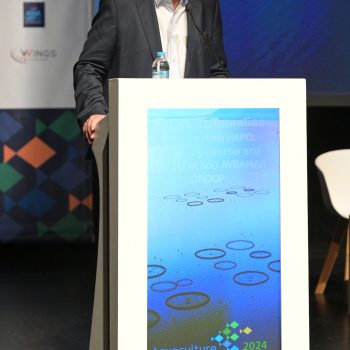
Mr. Apostolos Touralias, Chairman of the Board, emphasized the need for the timely establishment of the Organized Aquaculture Development Zones (POAY), seeking answers to ensure the current production process in the short term and its developmental prospects in the long term: “We ask for laws to be enforced and applied in all directions. Spatial planning is the quintessential development tool: it delineates, sets criteria, promotes environmental assessment, evaluates productive capacity, sets operational rules, and controls. There is no more room for delay; it is of utmost priority.” At the Conference, the current state of the industry was comprehensively assessed, and the factors that determine its resilient future were discussed, such as addressing investment challenges, promoting sustainable and environmentally responsible practices to mitigate the impacts of climate change, enhancing competitiveness, encouraging innovation through the adoption of advanced technologies, developing new products, exploring forecasts for global demand for aquaculture products, and promoting international cooperation and partnerships. Overall, the nutritional value, contribution to health, and well-being of consumers were highlighted.
HAPO had a strong presence with significant interventions in all sessions of the Conference: Regarding “Investments and Financing in Aquaculture,” Mr. Spyros Giannoulatos, Board Member of HAPO, emphasized that “…while the period 2022-2023 was difficult, from 2024 we look forward to recovery through solutions to structural problems plaguing the sector.” Ms. Lara Barazi Geroulano, President of the Federation of European Aquaculture Producers (FEAP) and HAPO Board Member, referred to the industry’s small environmental footprint and the catalytic impacts of the climate crisis on biodiversity, fish stock health, and local communities dependent on aquaculture. In the discussion on “International Market Trends for Aquaculture Products,” Mr. Nikos Lymberis, Vice President of the HAPO Board, pointed out: “We will soon see a shift from fresh fish on ice to ready-to-eat delicacies due to consumer demand for convenience.” Addressing topics related to “Health & Aquaculture,” Mr. Konstantinos Bokas, Treasurer of HAPO, said, “…we are environmental advocates as any burden on it affects the health of the fish and, consequently, our businesses.” At the Working Table on “Policy & Funding,” Mr. Ioannis Hekimoglou, Secretary-General of HAPO, regarding European aquaculture policy, noted that “the lack of coherence with other EU policies facilitates the import of fishery products produced in third countries with different standards, making them cheaper and therefore more attractive to the consumer.” According to Mr. Touralias, “…the conference will be a significant success if the discussions developed on the goals move from theory to practice, if the prospects for the conclusion of intergovernmental agreements are realized, and if our knowledge on scientific issues is enriched through the discussions, forming the foundation for the prosperity and well-being of our fish, the marine ecosystem, and the environment.”



Your privacy settings
Manage Consent Preferences
Necessary
Analytics
Marketing
Google Fonts
Embedded Videos
